Every time a piece of land changes hands in Pakistan, the registry office is only half the story. The other half is written by the Federal Board of Revenue (FBR), which collects advance tax on property transactions under specific sections of the Income Tax Ordinance. Two of the most commonly confused sections are 236K and 236C — and tonight’s question is about the first one. Getting this wrong can cost a buyer or a seller real money at the registry counter, so this is one detail every landowner, buyer and seller should know by heart.
Aaj ka sawal
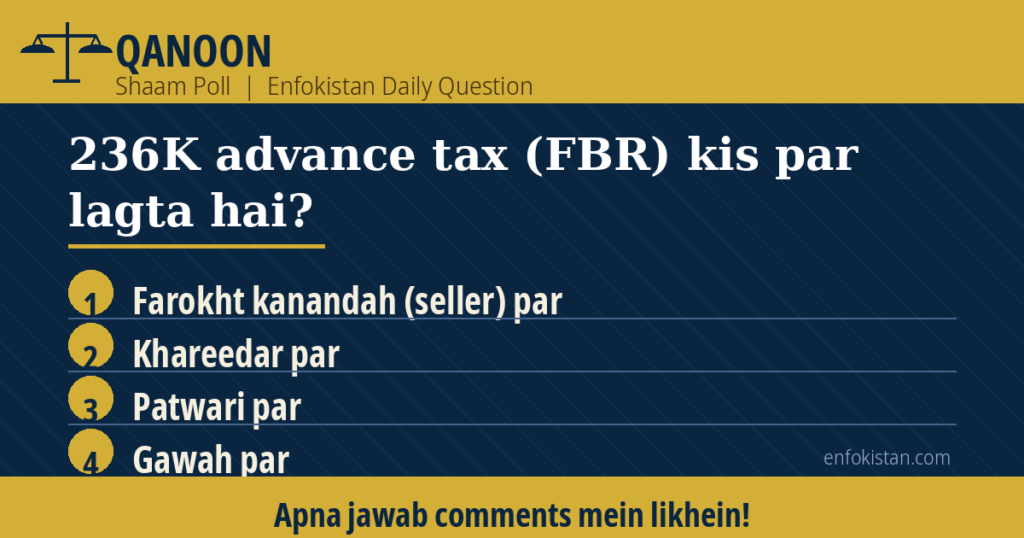
236K advance tax (FBR) kis par lagta hai?
- Farokht kanandah (seller) par
- Khareedar par
- Patwari par
- Gawah par
236K aur 236C mein farq samjhein
Section 236K applies to the seller of immovable property. When land is sold, an advance tax is collected from the person transferring the property, calculated as a percentage of the declared value or the DC valuation — whichever is higher. The rate is lower for filers and noticeably higher for non-filers, which is why checking your filer status before a sale can save lakhs of rupees. The collecting agent is usually the authority registering or recording the transfer, such as the sub-registrar.
Section 236C, by contrast, applies to the buyer of immovable property. Advance tax is collected from the purchaser at the time of purchase, again computed on the higher of the transaction value or the DC valuation. So in a single sale, advance tax is collected twice — once from the seller under 236K and once from the buyer under 236C. Mixing the two up is the most common confusion: remember the letter K for the one who leaves (the seller), and C for the one who comes in (the customer/buyer).
Both taxes are “advance” taxes, meaning they are adjustable against the person’s final tax liability for the year. They are not extra penalties — they are collected in advance and credited later. But at the registry counter they are a very real, immediate cost, which is why knowing exactly who pays what matters before you sit down to sign a deed.
Apna jawab comments mein likhen!
Zameen ki khareed-farokht se pehle ye farq aap ko kitna kaam aata hai? Kya aap 236K aur 236C ke rates apne ilaqe ke DC valuation par laga kar dekh chuke hain? Apna jawab aur apna tajurba neeche comments mein zaroor likhein — aap ka aik comment kisi aur dost ki lakhon ki ghalti rok sakta hai.
Ye baat sab se zyada log kyun ghalat samajhte hain?
Most people assume that only the buyer pays tax, or they treat stamp duty and advance tax as the same thing. Stamp duty is a provincial charge on the deed itself; advance tax is a federal (FBR) charge on the person — seller or buyer. Another common mistake is assuming the “market value” decides everything, when in fact the tax is calculated on the DC valuation rate if that is higher than the declared price. This is exactly why checking your mouza’s DC rate before a deal is not optional — it directly changes the tax you will pay at the counter.
#StampDuty #Registry #DCValuation #Enfokistan
🔗 Enfokistan — har jagah follow karein:
▶️ YouTube: https://www.youtube.com/@EnfokistanPK
💬 WhatsApp Channel: https://whatsapp.com/channel/0029Vabi9wYAO7RBCrtXEh40
📌 Pinterest: https://www.pinterest.com/enfokistan
🌐 Website: https://enfokistan.com