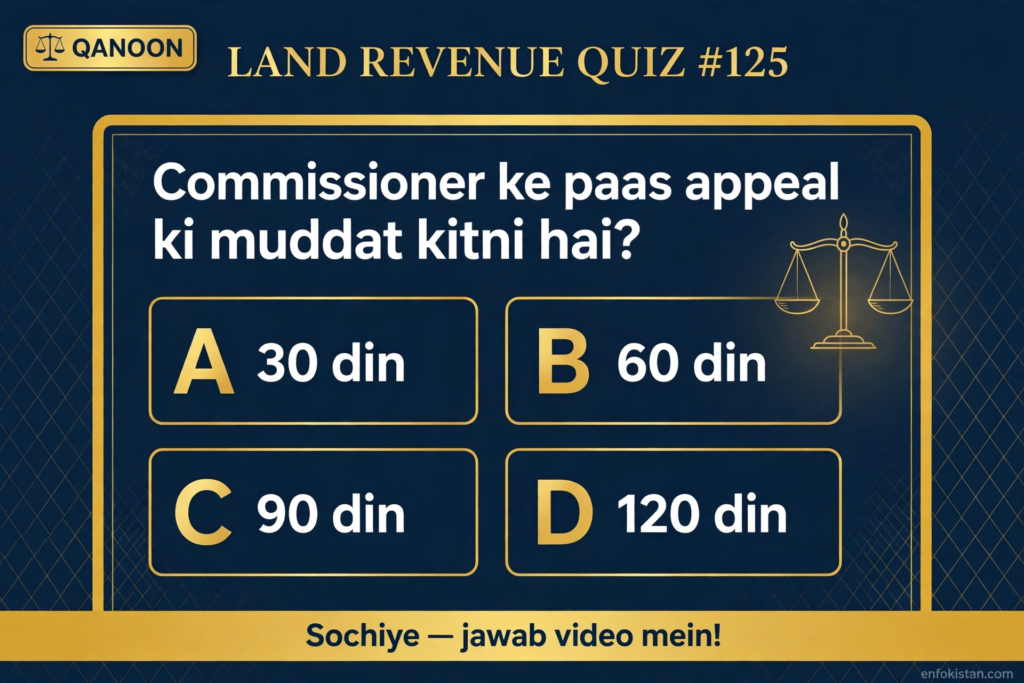
Land Revenue Quiz #125 — Commissioner ke paas appeal ki muddat kitni hai?
In land revenue work, knowing the law is only half the job — knowing the time limit is the other half. A perfectly strong case can be lost simply because the appeal was filed one day late. Every patwari, landowner and litigant in Punjab should know exactly how many days they have to challenge a revenue order, and before which authority. That is why today’s quiz is about the limitation period for an appeal to the Commissioner.
Aaj ka sawal
Commissioner ke paas appeal ki muddat kitni hai?
- A: 30 din
- B: 60 din
- C: 90 din
- D: 120 din
Durust jawab: B — 60 din
The correct answer is 60 days. Under the Punjab Land Revenue Act, 1967, the limitation period for filing an appeal before the Commissioner is sixty days from the date of the order being challenged. This is a fixed statutory period, and the appellate forum will first check whether the appeal is within time before it ever looks at the merits of the case.
The three rungs of the revenue appeal ladder are easy to remember once they are seen together: 30 days for an appeal to the Collector, 60 days for an appeal to the Commissioner, and 90 days for an appeal to the Board of Revenue. The most common mistake in this quiz is mixing up these three figures — many people answer 30 days because that is the period for the Collector, or 90 days because that is the period for the Board of Revenue. Each forum has its own clock, and the Commissioner’s clock is sixty days.
Two practical points matter as much as the number itself. First, the sixty days are generally counted from the date of the order, and the time properly spent in obtaining a certified copy of the order is excluded from the calculation — so the copy should be applied for immediately, not after weeks of delay. Second, an appeal filed after the limit is liable to be dismissed as time-barred unless the appellant can show sufficient cause for the delay and the forum condones it. Condonation is a discretion, not a right, so no one should plan around it.
Background: appeal ka nizam kaise kaam karta hai
In everyday revenue work, the orders that most often go in appeal are familiar ones: a mutation (intiqal) sanctioned or refused, a girdawari entry corrected or disputed, a partition order, or a correction of the record of rights. When a party feels the order is wrong, the appeal is the first and proper remedy — it goes up the hierarchy instead of starting a fresh case. The appeal must carry a certified copy of the order under challenge, clear grounds stating why the order is wrong, and the prescribed court fee.
For field staff, this period is a working tool, not just an exam fact. A patwari who knows the sixty-day rule can tell a villager the correct forum and the correct deadline on the spot, instead of sending him to the wrong office after the time has already run out. For landowners, the lesson is simpler still: the day an adverse order is passed, the calendar starts. Get the certified copy, prepare the grounds, and file within sixty days — a late appeal, however strong on facts, may never be heard at all.
Video dekhen: https://www.youtube.com/playlist?list=PLIHI8XcYyiZo
#LandRevenueQuiz #Patwari #Enfokistan
🔗 Enfokistan — har jagah follow karein:
▶️ YouTube: https://www.youtube.com/@EnfokistanPK
💬 WhatsApp Channel: https://whatsapp.com/channel/0029Vabi9wYAO7RBCrtXEh40
📌 Pinterest: https://www.pinterest.com/enfokistan
🌐 Website: https://enfokistan.com