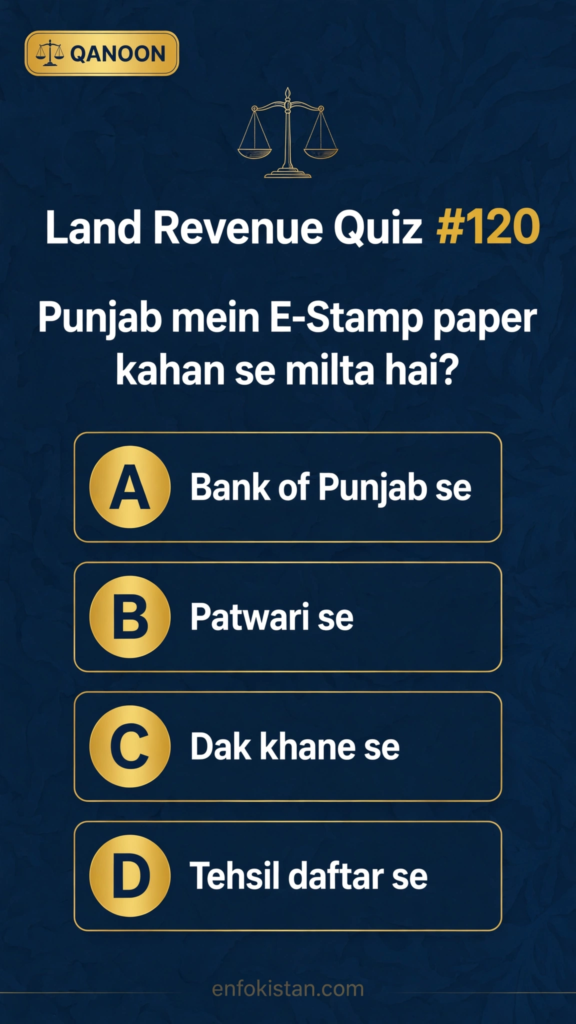
Stamp paper is one of the most common documents in land revenue work in Punjab. Every property sale, registry, affidavit, agreement and court filing needs stamp duty paid in the correct way. Yet many people still go to the wrong office, or buy old-style manual stamp paper from a vendor, and only discover the mistake when their document is rejected. Today’s quiz tests exactly this practical point.
Today’s Question
Punjab mein E-Stamp paper kahan se milta hai?
- A. Bank of Punjab se
- B. Patwari se
- C. Dak khane se
- D. Tehsil daftar se
Durust Jawab: A — Bank of Punjab se
The correct answer is A — Bank of Punjab. In Punjab, e-Stamp paper is issued through the Bank of Punjab under the provincial e-Stamping system. A citizen applies for an e-Stamp, pays the stamp duty, and receives an e-Stamp certificate carrying a unique verification number. That certificate, not a handwritten paper from a shop, is the legally recognised proof that stamp duty has been paid.
The system was introduced to end the forgery and overcharging that plagued manual stamp papers. Under the old system, stamp vendors could sell fake or reused stamp papers, and verifying a stamp’s genuineness was difficult. With e-Stamping, every certificate is generated against a central record, and anyone — a patwari, a registrar, a bank or a court — can verify the e-Stamp number online in seconds. The Stamp Act, 1899 still governs the duty itself, but the method of issuing the stamp in Punjab is now electronic, and the Bank of Punjab is the authorised issuing channel.
The most common mistake is to assume the patwari or the tehsil office issues the stamp. They do not. The patwari’s role is in the revenue record — fard, intiqal, girdawari — while the tehsil office handles administrative matters. Neither counter issues e-Stamp paper. Similarly, the post office has no role in stamp issuance. People who visit these offices are simply sent on to the bank, losing a day in the process.
Background: How E-Stamping Works in Practice
For a property transaction, the buyer first calculates the stamp duty on the transaction value. The duty is paid through the e-Stamp system, and the Bank of Punjab issues the e-Stamp certificate against the payer’s CNIC and the property details. The certificate carries a unique e-Stamp number, the duty amount, the names of the parties, and the purpose of the stamp. At the time of registry, the Sub-Registrar verifies the certificate before the transaction is recorded.
The same system covers affidavits, agreements, power of attorney documents and court-related stamps. The key practical points are simple: always obtain the e-Stamp from the authorised bank channel, keep the certificate safe, and verify the e-Stamp number before presenting the document anywhere. A stamp bought from an unauthorised seller, however genuine it looks, can be rejected — and a rejected stamp means the whole document, and the fee paid for it, is wasted.
For patwaris and field staff, this is daily working knowledge. Clients constantly ask where to get stamp paper, and the correct guidance — Bank of Punjab, through the e-Stamp system — saves them a wasted trip to the tehsil office or the patwarkhana. For landowners, knowing the right channel also protects against touts who charge extra for arranging stamps.
Video dekhen: https://www.youtube.com/playlist?list=PLIHI8XcYyiZo
#LandRevenueQuiz #Patwari #Enfokistan
🔗 Enfokistan — har jagah follow karein:
▶️ YouTube: https://www.youtube.com/@EnfokistanPK
💬 WhatsApp Channel: https://whatsapp.com/channel/0029Vabi9wYAO7RBCrtXEh40
📌 Pinterest: https://www.pinterest.com/enfokistan
🌐 Website: https://enfokistan.com