When a land dispute reaches court, one of the first things people ask for is a stay order. Yet very few understand what it actually does. A stay order can freeze a sale, stop construction, or prevent a change of possession — but it does not decide who owns the land. That distinction matters, because treating a temporary protection as a final victory is one of the most common and costly mistakes in revenue and civil litigation.
Today’s evening poll asks a simple question that tests exactly this understanding. Thousands of landowners, farmers and buyers face this issue every year, and the wrong answer can mean years of litigation, lost money, or even a contempt notice. Before you vote, read the background below — and then tell us your answer in the comments.
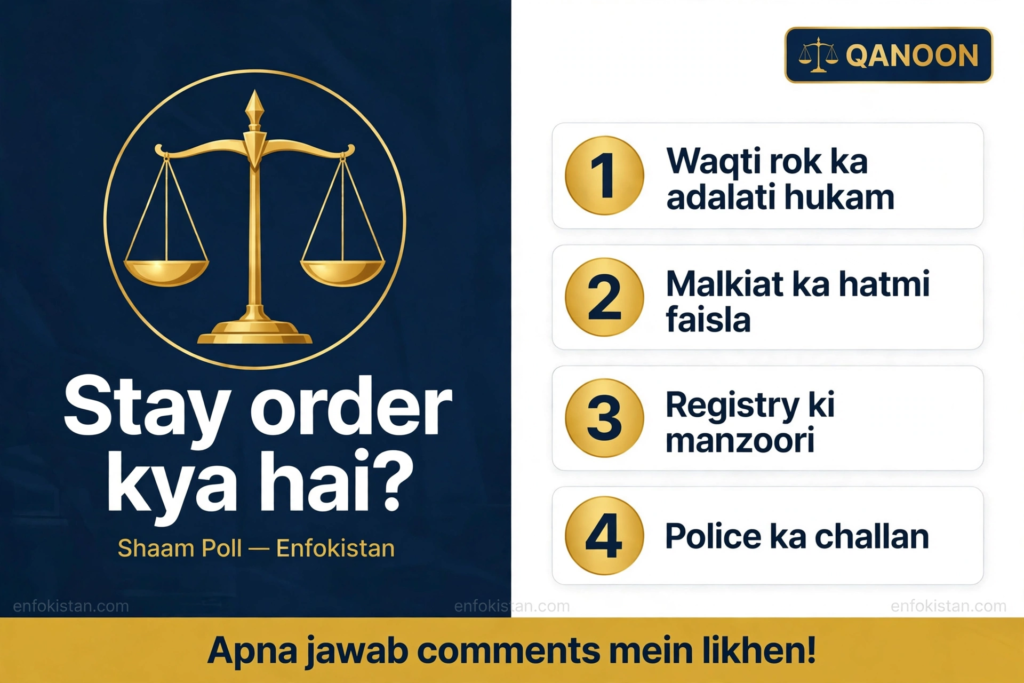
Aaj ka sawal
Sawal: Stay order kya hai?
- Waqti rok ka adalati hukam
- Malkiat ka hatmi faisla
- Registry ki manzoori
- Police ka challan
Stay order kya hota hai?
A stay order — in Urdu, hukm-e-imtinaee — is a temporary order by which a court restrains a party from doing something until the case is decided. In civil litigation it is usually granted as interim relief under Order 39, Rules 1 and 2 of the Code of Civil Procedure, 1908. The court may stop a sale, halt construction, or freeze any change in possession while the suit is pending. In revenue matters, similar interim protection can be sought before the revenue courts — the Tehsildar, Assistant Commissioner and Deputy Commissioner — while an intiqal, partition or girdawari dispute is being heard.
The key word is temporary. A stay preserves the position as it is; it does not declare ownership, cancel a registry, or settle the dispute. The case itself must still be fought, evidence must still be produced, and hearings must still be attended. A stay can be vacated, modified, or allowed to lapse if the party who obtained it stops pursuing the case. Many people learn this the hard way: they obtain a stay, relax, miss their dates, and then find the protection gone and the other side free to act.
There is also a serious side. Disobeying a stay order is contempt of court. Building on land, selling it, or changing possession in defiance of a stay can lead to fines and even imprisonment. A stay is therefore not a piece of paper to be filed away — it is a live court order that must be respected by both sides until the court says otherwise.
Apna jawab comments mein likhen!
Ye kyun zaroori hai?
Most people get two things wrong. First, they confuse a stay with a decision: a stay being granted does not mean the case has been won. Second, they assume the stay protects them forever without any further effort. In reality, a stay is only as strong as the case behind it. Keep your file ready, note every hearing date, stay in touch with your lawyer, and never treat interim relief as a substitute for preparing the main case.
If you are involved in a land dispute, ask your lawyer three questions on day one: is a stay needed, what exactly does it restrain, and until when does it remain in force? Those three answers will save you from most of the confusion that surrounds stay orders.
#StayOrder #CourtCase #HukmImtinaee
🔗 Enfokistan — har jagah follow karein:
▶️ YouTube: https://www.youtube.com/@EnfokistanPK
💬 WhatsApp Channel: https://whatsapp.com/channel/0029Vabi9wYAO7RBCrtXEh40
📌 Pinterest: https://www.pinterest.com/enfokistan
🌐 Website: https://enfokistan.com